Research and development, production, and sales of intelligent equipment for automatic welding machine.


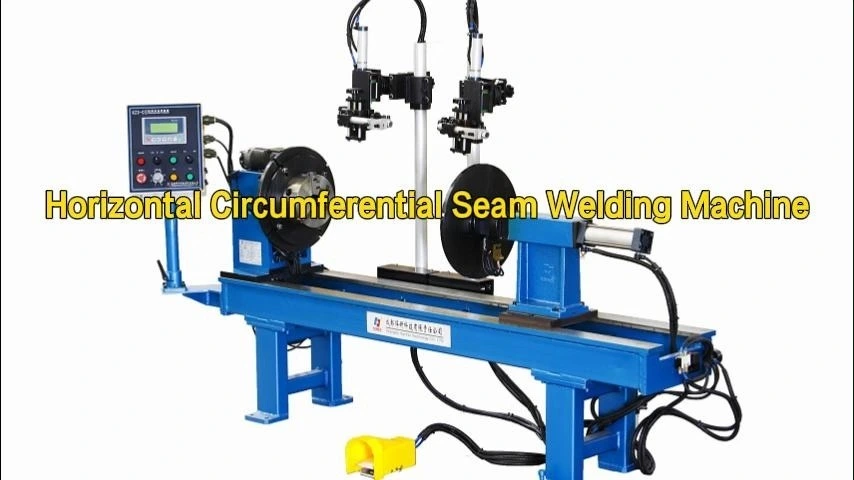
Horizontal Circumferential Seam Welding Machine
The horizontal circumferential seam welding machine is one of the core models of general welding equipment. It is mainly used for circumferential seam welding of various circular and annular workpieces, and is widely applied in many industries such as machinery manufacturing, pressure vessels, pipeline engineering, auto parts, and hardware products. With the characteristics of high welding precision, stable efficiency and convenient operation, it has become an indispensable automatic welding equipment in mass production.
This horizontal circumferential seam welding machine adopts a horizontal layout design. After the workpiece is clamped, its axis is in a horizontal state, which is accurately matched with the movement track of the welding head, effectively avoiding the impact of the workpiece's own weight on welding precision in the vertical layout.
The horizontal circumferential seam welding machine is adaptable to the welding of various materials such as low carbon steel, stainless steel, alloy steel and non-ferrous metals, supports various welding methods including manual argon arc welding, gas shielded welding and submerged arc welding, and can be flexibly adjusted according to workpiece specifications and welding requirements. Its clamping system adopts a centering and clamping mechanism, which can realize rapid positioning and firm clamping of the workpiece, effectively prevent workpiece deviation during the welding process, and ensure the coaxiality of the circumferential seam and the quality of weld formation.
The horizontal circumferential seam welding machine has good versatility and expandability. According to the user's actual production needs, it can be equipped with clamping tools, welding heads and auxiliary equipment of different specifications, adapting to annular workpieces of different diameter ranges. It can not only meet single-piece and small-batch production, but also adapt to mass assembly line operations.
Compared with traditional manual welding, the horizontal circumferential seam welding machine not only greatly improves welding efficiency, but also significantly enhances the stability of weld quality, reduces welding defects, and lowers labor costs and rework rates. It is an important equipment for realizing automatic and standardized production in the general welding field, providing strong support for the improvement of product quality and production efficiency in various industries.
5.0
design customization
Please fill out the form below to request a quote or to request more information about us. Please be sure to upload customized requirement documents or pictures, and we will get back to you as soon as possible with a response. we're ready to start working on your new project, contact us now to get started.
Please fill out the form below to request a quote or to request more information about us. please be as detailed as possible in your message, and we will get back to you as soon as possible with a response. we're ready to start working on your new project, contact us now to get started.
Horizontal Double Circumferential Seam Welding Machine
1. Professional Horizontal Design: Suitable for cylindrical workpieces, stable placement, less deformation, high precision.
2. Efficient Double Seam Welding: Dual seams at one time, shorter cycle, higher efficiency, lower labor cost.
3. Versatile & Easy Operation: Three-jaw chuck (wide adaptation); tailstock center for quick positioning.
4. Stable & Reliable: Optimized structure, low failure rate, supports long-term high-load work.
5. Precise Welding: Precise positioning, fewer defects, meets industrial standards.
Horizontal Circumferential Seam Welding Machine
1. Professional Horizontal Design: Suitable for cylindrical workpieces, stable placement, less deformation, high precision.
2. High Welding Efficiency: Smooth operation, short cycle, low labor cost, improving production efficiency.
3. Versatile & Easy Operation: Three-jaw chuck (wide adaptation); tailstock center for quick positioning.
Precision Circumferential Weld Workbench
The precision circumferential weld workbench is an automated welding equipment specially designed for the circumferential welds of circular/annular workpieces. Its core is to drive the workpiece to rotate at a constant speed through a high-precision rotation system, and cooperate with a fixed/adjustable welding torch to realize automatic, uniform and high-quality welding of circumferential welds; it also supports some longitudinal weld welding scenarios and is widely used in the manufacturing of pipelines, flanges, pressure vessels, auto parts, hydraulic cylinders, etc.
{{item.score}} Stars
{{item.pre}}%
{{item.nickname ? (item.nickname.slice(0, 2) + '*****') : item.source === 1 ? 'mall buyer' : '--'}}
{{item.comment_time}}
Review in the {{item.country}}
{{itemAttr.params_key}}: {{itemAttr.params_value}}
Get in touch with us
Just leave your email or phone number in the contact form so we can send you a free quote for our wide range of designs
We focus on providing automotive fuel tank welding equipment and welding production lines, medium frequency spot welding machines, etc. to various industries.
Quick links
Products
Contact Us
Add: NO.18.Hangtian Rd.Longtan Industrial Development,China.
Copyright © 2026 Welding Research Intelligence | Sitemap | Privacy Policy